Anatomy of a Mask: How Horror's Most Iconic Killers Hide in Plain Sight
The masked killer has become a cornerstone of the horror genre, evolving from a simple disguise to a complex narrative device. This archetype's power lies in its ability to erase humanity and reflect audience fears.

The Blank Slate of Terror
The most enduring monsters in horror cinema are often not supernatural beasts or creatures from the void, but human figures whose faces we cannot see. From the expressionless white visage of Michael Myers to the grinning nihilism of a Purge participant, the masked killer has become one of the genre’s most potent and recognizable archetypes. The device is deceptively simple, yet its psychological impact is profound. A mask strips away identity, empathy, and motive, transforming a character from a person into an implacable force, a blank surface onto which an audience projects its deepest anxieties about mindless, inexorable violence.
This tradition predates the modern slasher, with roots in films like Georges Franju’s Eyes Without a Face (1960). But it was in the late 1970s that the trope was codified into the form audiences recognize today. The mask serves a dual purpose. For the filmmaker, it is a practical tool that creates an instantly marketable icon, a visual shorthand for the entire franchise. For the viewer, it is a narrative catalyst. Without a face to read for emotion or intent, the killer becomes a puzzle, and their silence is more terrifying than any threat. They are not a character to be understood, but a phenomenon to be survived.
Codifying the Archetype in the Slasher Golden Age
John Carpenter’s Halloween (1978) is the foundational text for the modern masked killer. The story behind the mask is part of industry lore: production designer Tommy Lee Wallace famously purchased a William Shatner Captain Kirk mask for $1.98, modifying it by widening the eye holes and painting it a ghostly white. The result was what cast and crew referred to as “The Shape,” a name that perfectly encapsulates its function. The mask turned a human actor, Nick Castle, into an entity that moved with an unnatural gait and observed its victims with a chilling lack of passion. It dehumanized Michael Myers, making his evil feel elemental rather than personal.
Following the commercial success of Halloween, the slasher subgenre exploded in the early 1980s, and with it came a wave of imitators seeking their own iconic masks. In the Friday the 13th franchise, Jason Voorhees did not acquire his signature hockey mask until the third installment in 1982. The mask, discovered by chance by the character Shelly, was originally a simple piece of sporting equipment. Yet, its stark utility and emotionless stare became synonymous with the unstoppable killer, proving that the iconography of horror is often born from improvisation. The hockey mask, like Michael’s Shatner disguise, became a pop culture artifact far exceeding its humble origins and cemented the mask as a prerequisite for any aspiring slasher villain.
Deconstruction and the Transferable Threat
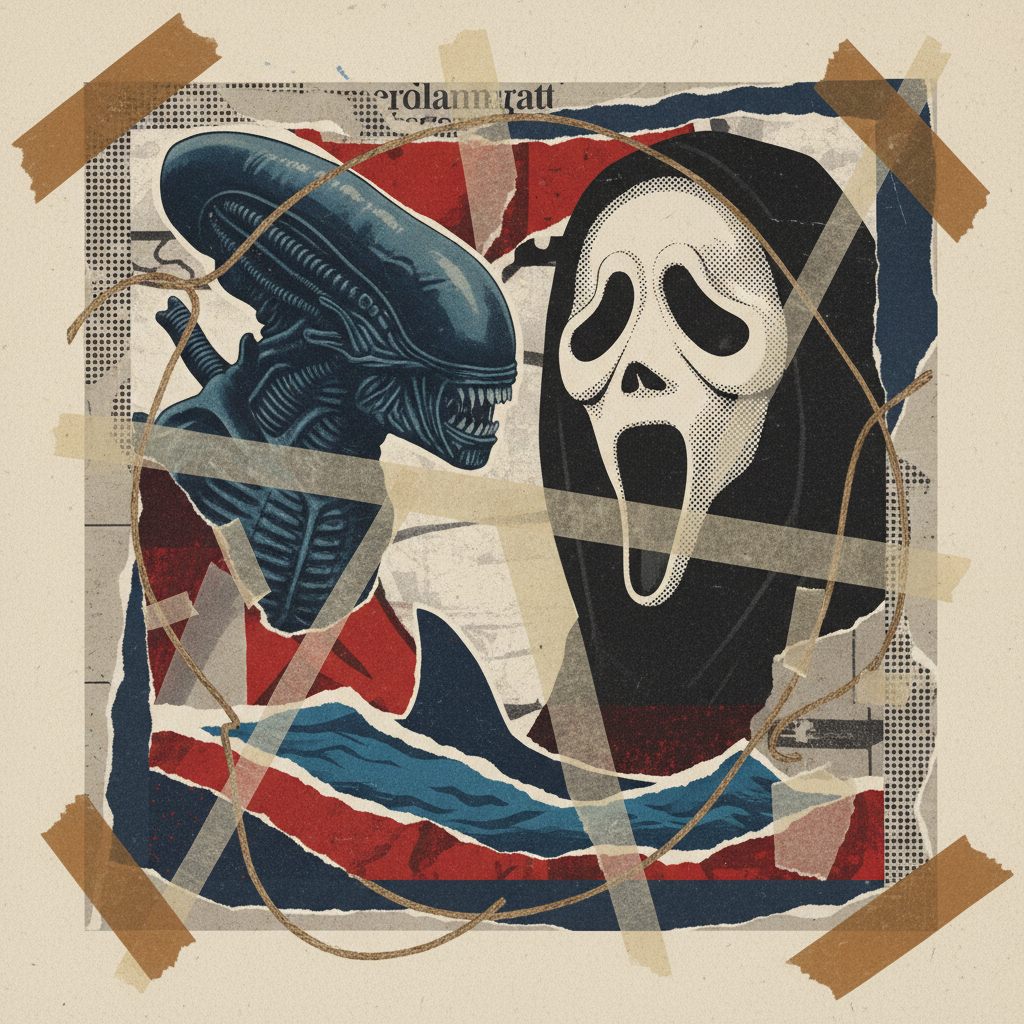
For nearly two decades, the masked killer was a singular, almost supernatural figure. The mask was inextricably linked to one specific character, be it Michael Myers or Jason Voorhees. Then, in 1996, Wes Craven and Kevin Williamson’s Scream dismantled the trope and rebuilt it for a new generation. The genius of Ghostface was that the mask was not the identity of the killer; it was a costume bought off a shelf, available to anyone. This transformed the nature of the threat from a singular force to a transferable identity.
The question was no longer where is Michael Myers, but who is Ghostface? The mask, a version of the “Peanut-Eyed Ghost” manufactured by the Fun World costume company, became a symbol of the killer’s core taunt: the danger could be anyone, from a boyfriend to a best friend. Scream turned the mask from a tool of dehumanization into a plot device for a whodunit. It shifted the audience's fear from the unstoppable monster to the terrifying idea that the monster could be standing right next to you. This meta-commentary revitalized the genre and introduced a new, more cynical psychology to the masked killer archetype.
The Mask in the Modern Era
The 21st century has seen the masked killer evolve further, often reflecting contemporary social anxieties. Bryan Bertino’s The Strangers (2008) introduced a trio of antagonists whose simple, doll-like masks created a profound sense of the uncanny. Their coverings were unsettlingly mundane, suggesting a lack of elaborate motive. When asked why they were terrorizing a couple, one killer’s reply, “Because you were home,” became one of the most chilling lines in modern horror. The masks amplified the randomness and senselessness of the violence.
Similarly, franchises like The Purge use masks as a symbol of societal collapse and sanctioned anarchy. Here, the masks are not about concealing one killer’s identity but about signifying a collective abandonment of civility. The grinning, distorted faces worn by Purgers represent a gleeful descent into humanity’s worst impulses. Other modern films, like You’re Next (2011), use animal masks to give their killers a feral, predatory quality, tapping into primal fears. From home invasion thrillers to social satires, the mask remains a versatile and powerful tool for filmmakers to explore what horrors lie just beneath the surface of the ordinary world, ready to be unleashed the moment identity is concealed.